How can social media enhance democracy?
by Nicolas Hénin, Project Consultant, author, and journalist
Whilst social media has taken centre stage in public life, serving as a source of information and a forum for public debate, it has also revealed a dark side: toxicity, polarisation, manipulation of information… In this blogpost, I identify four variables in an attempt to improve social media by realigning it with the ideals of the early internet: interoperability, decentralisation, control over algorithms and portability.
Political systems are intimately shaped by the circumstances of their era. Democracy was devised around the Greek agora—a public square serving as a space for discussion among citizens—and experienced a new surge, aided by the invention of printing, during the Enlightenment. Consequently the press emerged as the “fourth estate”, popularising the dissemination of hierarchical and verified information and possessing the means to investigate. Digital technology, and above all the internet, has over the past quarter of a century profoundly altered the way in which citizens obtain information and engage in debate. Major platforms, particularly those controlling social media networks, have become gatekeepers, guardians of the temple who wield disproportionate influence over the structure of debates. Elon Musk, spending billions—and devoid of any hope of a return on his investment— buying Twitter (which he rather quickly wrecked, like a spoilt child smashing his new toy) is the most striking recent illustration of this. This crucial position makes social media a prime target for those seeking to exert political influence, whether by taking control of platforms through acquisitions or by carrying out manipulation campaigns. Therefore, the proper governance of platforms has become an essential condition for the seemly functioning of democracy.
The European Union has recognised this and introduced a host of regulations (DSA, DMA, EMFA…) in an attempt to safeguard the integrity of public debate and prevent abuse. In particular, it has fully recognised the potential for destabilisation posed by the sector’s largest players, known as VLOPs (Very Large Online Platforms), to whom stricter obligations have been imposed. But this recognition is continuously countered by the dominion of the platforms—powerful players driven by their own financial and political interests, equipped with armies of lawyers and communication specialists enabling them to lobby legislators and navigate the regulatory jungle as best they can. Recent history has shown that they ultimately attach little importance to the well-being of their consumers or to their contribution to improving society.
The business model of big tech has shown its limitations. Its initial appeal is undoubtedly its low or zero entry cost. The internet user opens an account and is offered a free service. Over time, they naively entrust their data and their work to the platform, developing interactions, their activity and even their brand. Eventually, the platform sells them additional services to supposedly “enhance their user experience”. Then, sometimes after being acquired, the platform offers increasingly inappropriate services, adverts become intrusive, data-sharing permissions become excessive, yet there is no way to refuse: the service becomes too downgraded if the user does not accept the terms.
Competing services do exist, but they too have their drawbacks. Moreover, the user has grown accustomed to the platform’s environment. To switch, they would have to start from scratch, rebuild their entire network, their brand image, and their recorded activity. The platform has become mired in this process known as ‘enshitification’ (as defined in a book by Cory Doctorow), whilst the user is trapped. Leaving requires too much effort and there is no guarantee that a different platform, in the long run, does not go down the same path. The profits of many digital giants rely on this gap between zero entry costs and very high exit costs.
Yet several technical solutions do exist that allow us to imagine a freer digital future. Most of them involve moving away from the platform model and towards that of protocols, as outlined in a seminal article by Mike Masnick, ‘Protocols, Not Platforms: A Technological Approach to Free Speech’, written as early as 2019. First and foremost, no one could take control of a protocol, neither by force nor money. We recall the mockery that followed Elon Musk’s attempt to buy Wikipedia. This ignored the very nature and foundation of Wikipedia, which cannot be sold. The users effectively control it. It would be laughable if Google claimed a right to buy the protocols on which email is based in order to impose a Gmail monopoly on all electronic mail users.
What conditions would social media platforms need to meet to restore the balance of power, to find a middle ground between controlling what is said and respecting freedom of expression, between economic equilibrium and the collective interest? I see four: interoperability, decentralisation, control over algorithms and portability.
Interoperability is what prevents you from being locked into a single, imposed service provider. Even if you can export data or interact with other platforms (such as posting on a website), you remain dependent on the proprietary application (TikTok for TikTok, Facebook for Facebook, and so on). In contrast, email protocols (SMTP, IMAP, etc.) are interoperable. Service providers work together seamlessly, and you can host your own email. This has even driven commercial players towards interoperability; you can use the Gmail app or website to manage email from another provider or your own domain name. Conversely, you can have a Gmail address without ever using its web or mobile apps, but via other clients such as Thunderbird or the iPhone’s mail app. Tweetdeck had opened up the Twitter environment somewhat before being acquired by X, which restricted its API to third-party apps. Commercial social networks want you to stay with them and use their products. They impose closed environments on you. They don’t even want you to click on links to external sites, even though these sites might give you the means to source information or judge its reliability.
Decentralisation is the corollary of interoperability. It empowers user communities by giving them a choice of platform, or at least offering some alternative. Users can choose their instance (a term used in the Fediverse, the Mastodon universe) or their PDS (Protocol AT Service Provider, used by Bluesky, amongst others). Each server can adjust its rules, particularly regarding moderation or sharing of data for commercial purposes, which, additionally, raises a monetisation issue. (As decentralised networks are not-for-profit, they risk facing funding problems in the long term). The proliferation of servers allows users to choose their geographical location (and the laws governing it) and offers greater resistance to censorship. In practice, Paul Frazee points out in a blog post that decentralisation can take several forms, ranging from federated networks (such as email or Mastodon) to what he describes as ‘magic meshes’ (such as torrents or blockchain). The ATmosphere, in which Bluesky operates, is, in his view, a sort of synthesis of these models: “federated magic meshes”.
In a decentralised environment, the various stakeholders must agree on a governance model and take a stance concerning the notorious tension between freedom of expression and user protection. But here again, the “protocol” perspective demonstrates its superiority over platforms. One of the challenges facing platforms in recent years has been having to decide when harmful speech (extremist, hateful, anti-vax, etc.) should be removed, sparking endless debates about the right balance between freedom of expression and public order. A decentralised social network does not face nearly as many dilemmas. It relies on the user community to marginalise abusive speech and behaviour. If everyone can choose what appears on their timeline, hide a trollish comment or effectively block a harasser, moderation is reduced to a marginal role. By its very design — safe by design — the network weeds out the troublemakers.
Granted, these individuals will not necessarily be expelled from the platform, but they are destined to find themselves quickly confined to its fringes, visible only to themselves and able to interact only with one another. The hope is ultimately that they will grow weary and leave. An instructive example was the attempt by a white supremacist community, the Bouli, to infiltrate Bluesky. The tools for blocking and reducing visibility are so powerful that the few dozen accounts which tried to break through with hateful trolling quickly ran out of steam and returned to Twitter to mock, sheepishly, the “network of losers”.
Granted as well, decentralisation can lead to conflicts over moderation or the fragmentation of the environment of debate, conflicts which we are already seeing emerge between a progressive Bluesky or Mastodon and an X that is wide open to the far right (this fragmentation already exists since X is not decentralized). But we must not exaggerate the effects of this fragmentation. Just because one section of society seeks refuge from the radicalisation of another does not necessarily mean there is polarisation, and, in an environment where hate and intolerance are prominent, what some commentators would describe as “echo chambers” or “filter bubbles” are in fact sometimes nothing more than safe spaces.
Control over algorithms is absolutely essential to ensure that users can decide what they see. At present, on an algorithmically curated social network (a term used notably by Jean-Louis Missika and Henri Verdier to describe networks where algorithms determine what is displayed). Yet it is not the user — despite their subscription choices — who chooses what appears on their timeline, but the platform that decides what to display. This allows for the imposition of targeted advertising, but also ensures that user engagement and time spent on the platform are maximised. The algorithm will, for example, favour shocking content that provokes a reaction, whilst reducing the visibility of posts containing links to external sites, which encourage the user to leave.
The starkest illustration of the algorithm’s role is the pornographic meme posted by Elon Musk after his takeover of Twitter, showing a woman being force-fed milk from a bottle. Whether the user likes it or not, whether they follow him or not, and even if they have blocked him, they will be forced to view the posts of the platform’s owner!
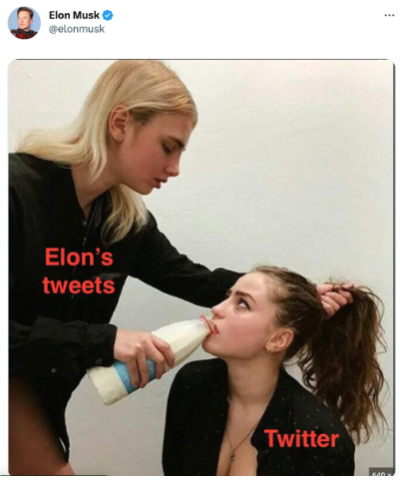
The manipulation of algorithms by platforms is no trivial matter. If the aim is to make the user addicted, the platforms do not shy away from, and are even interested in, a certain degree of toxicity. This toxicity, promoted by the techbros in the name of weaponising freedom of expression, drives them to tolerate, or even promote, abusive behaviour. Furthermore, regarding X, the political bias of the recommendation algorithm, which excessively promotes far-right content, has become glaringly obvious, as demonstrated by recent research published in Nature. For a long time, the main argument put forward by advocates of a better digital world was to call for transparency in algorithms, similarly to the transparency reports demanded by human rights organisations. It was this idea that inspired European legislators when they drafted the DSA, which provides for audits of the algorithms used by major internet platforms. It was a mistake. Recommendation algorithms are complex behemoths made up of vast amounts of code that auditors appointed by public authorities cannot fully comprehend, let alone without having full access to the inner workings of the system.
The best audit of an algorithm is undoubtedly the empirical experiment carried out by a few researchers and journalists who have shown, notably with TikTok, that by opening a ‘neutral’ account, with no particular interests, and scrolling through videos at random, it generally took them only a short time before they came across harmful, extremist, hateful or risk-inciting content. And yet, even these empirical experiments have their limitations. Researchers have found that certain platforms can detect when a user is testing them, and then switch to “virtuous mode”, much like Dieselgate – the scandal involving cars that recognised when they were undergoing a roadworthiness test and whose software adjusted to reduce emissions at precisely that moment. For an expert in the field who wishes to remain anonymous, auditing the algorithms of major platforms is simply not realistic because they are so complex that “even their designers do not know exactly what is in them, nor how they will behave”.
The solution therefore lies in giving control back to the user. Displaying a timeline without algorithmic curation (a simple, exhaustive chronological list of posts published by the accounts you follow) can prove frustrating. The ability to discover new content (known as ‘discoverability’) is important. Some are considering reintroducing buttons such as ‘show me more content like this’ or ‘show me less’, but users are often passive and appreciate the convenience of having an algorithm do the work for them.
In any case, regaining control means that users can choose between two feeds: “followers” and “for you”. The first one is a “subscriptions” feed, which offers no recommendations, highlights or reduced visibility. The second offers a choice of the algorithm(s) they wish to use. This movement was initiated by a group of experts who, in a September 2024 opinion piece, argued in favour of “algorithmic pluralism”. To achieve this, the signatories note, social media platforms must be open to third-party applications, rather than the closed and restrictive ecosystems they have become. Incidentally, this call for pluralism applies not only to social media algorithms but also to those of search engines.
Finally, portability is an essential condition for effective competition to take place, to avoid being trapped on a platform suffering from ‘enshitification’ and to be able to move one’s content, contacts, interactions and, often, the fruits of one’s labour, without having to endure a ‘cold start’: a profile with zero posts, zero accounts followed, zero followers. Portability is a practice that has become standard in mobile telephony and banking (just like interoperability: you can call all networks and make payments with all banks), allowing you to switch providers effortlessly. In the realm of social media, it is only possible with open and interoperable environments, i.e. currently within the ATmosphere and the Fediverse. Bluesky, champion of the ATProtocol, thus refuses to describe itself as a platform, and warmly welcomes ‘competing’ providers: Blacksky, Eurosky, Northsky and soon W and Gander. More than competitors, they are complementary. They broaden the offer. The ambition is to make the ATmosphere a pillar of the internet of tomorrow. There’s always room for more when building a world!
The next step will be to make the protocol the foundation of a renewed internet, equipped with numerous applications and uses. Bluesky’s ambition is that your username will soon be much more than just an account on a microblogging platform, becoming instead a gateway to hundreds of applications that aim to be less profit-driven and more respectful of users and the common good. Mainstreaming it will require a strong political impulse and corresponding investment from committed progressive states.